
RUBIC2026
Call for Pitches is closed!
🔵 Introduction
The RUBIC – Robotic Urology Breakthrough Innovation Challenge is an international competition organized within the ERUS26 Congress in Padua, Italy, aimed at fostering innovation in robotic urology and its future evolution.
RUBIC promotes the development of deep-tech ideas with strong clinical, technological, and entrepreneurial potential, encouraging collaboration between young clinicians, engineers, and innovators.
🔵 Scope of the Challenge
The challenge focuses on the integration of robotic urological surgery with advanced technologies, including:
- Artificial Intelligence and Machine Learning
- Digital Twins
- Mixed and Virtual Reality
- Human–Machine Interfaces
- Big Data and Predictive Analytics
- Simulation and Serious Games
- Telemedicine and remote support
Projects may address applications such as surgical training, intraoperative decision support, workflow optimization, and patient engagement.
🔵 Who Can Apply
The competition is open to multidisciplinary teams with:
- Minimum 2 members
- Maximum 6 members
- The project lead — who will present the project at the RUBIC Pitching Session — must be a urologist (resident or young specialist) and must be under 35 years of age at the time of submission.
- The majority of team members must be under 35 years of age at the time of submission.
- Strong encouragement for collaboration with engineers, data scientists, designers, or innovators
Physical participation at ERUS26 in Padua is required for selected finalists.
🔵 Submission Requirements
Participation is free of charge.
Each team must submit a structured abstract in English describing:
- The problem addressed
- The proposed solution and its innovation
- The technologies involved
- Potential clinical and/or market impact
- Future development and vision
- Team composition
🔵 Deadline
📅 Submission deadline: 31 July 2026 (closed)
🔵 Selection Process
A multidisciplinary committee of experts in robotic urology, biomedical robotics, innovation, and MedTech will evaluate submissions.
Five finalist teams will be selected and invited to present their projects at ERUS26 in Padua.
🔵 Final Session
Finalists will:
- Deliver a 10-minute pitch (7 presentation + 3 discussion)
- Present in front of an international jury
- Answer questions from experts
The winning project will be announced during the official session.
🔵 Award
The winning team will be awarded a prize of €5,000 and offered the following opportunities:
- European fellowship experience in robotic urology centers
- Access to mentorship and advisory programs
- Opportunity to present at MedTech Malta 2026
🔵 How the RUBIC2026 JURY scores the projects
The Official Rules set out ten evaluation criteria, grouped in five sections of equal weight, each scored from 0 to 5. What they do not say is who is entitled to judge what.
Why we changed something
The RUBIC Jury is deliberately heterogeneous: three robotic urologists, one biomedical robotics engineer, one deep-tech venture builder and one MedTech industry expert.
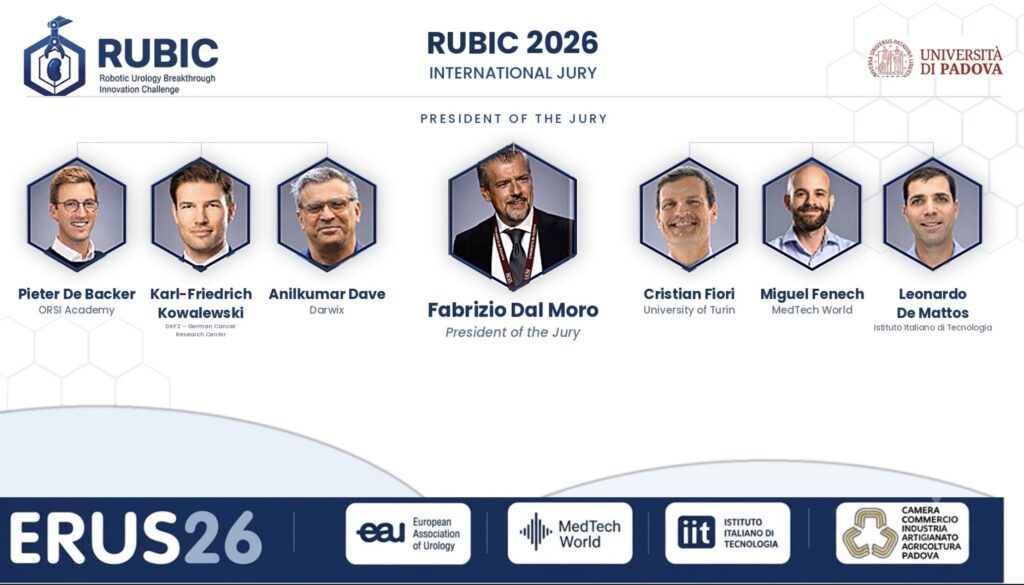
That mix is the point — the projects sit at the intersection of surgery, engineering and entrepreneurship, and no single discipline can assess them alone.
But a simple average across six jurors carries a hidden assumption: that all six are equally able to judge every criterion. Under a plain average, a venture builder’s opinion on the clinical impact of a project would count exactly as much as that
of a urologist who performs the operation, and a clinician’s opinion on market scalability exactly as much as that of the industry expert. Equal weighting is not neutrality. It is a specific assumption, and in a Jury built on complementary expertise it is the wrong one.
What we did
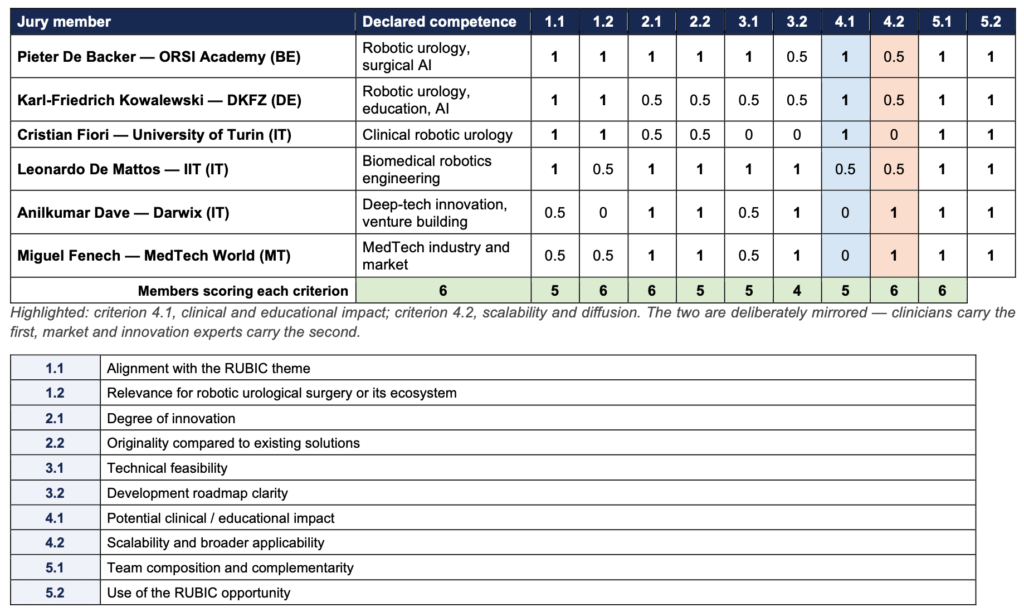
Each member of the Jury has been assigned a coefficient for each of the ten criteria:
– 1 — primary competence: the score counts in full.
– 0.5 — informed but secondary competence: the score counts half.
– 0 — outside the member’s declared profile: the criterion is not scored at all.
Within each criterion the coefficients are renormalised so that they sum to one. A member with a coefficient of 1 thereforecounts exactly twice a member with 0.5, and a criterion left unscored does not lower anyone’s average — it is simply not
counted. Only three levels were used. On small and noisy datasets, coarse weights are as accurate as finely calibrated ones, and a coefficient of 0.85 rather than 0.90 would be impossible to justify to a team that asked why. Three levels can be stated in one sentence and defended in a meeting. The coefficients, in full Each member reviewed and confirmed their own row before any project was read, and was free to decline a coefficient of 1 or to request a change. The matrix was then frozen and minuted. It has not been modified since, and it will not be modified while
scoring is under way.
What this changes, stated plainly
Weighting improves the fairness and the defensibility of the process more than it changes the outcome. In simulation on this exact matrix, the weighted result tracks the underlying ranking slightly better than a plain average — the difference is real but modest. We publish this because overstating the effect would be as misleading as hiding the method. No project wins or loses because of a coefficient; the coefficients ensure that each judgement is made by those competent to make it.
Conflicts of interest: one rule for everyone
A member of the Jury who declares a conflict of interest with a project does not score that project. The rule is uniform: it applies to every member and every project, without exception and without individual discretion.
We considered allowing a conflicted member to score anyway, with the score flagged. We tested it and discarded it.
Because jurors differ in how strictly they mark, and because a project assessed by five members is not assessed by the same panel as one assessed by six, letting each member choose whether to score would mean that a project gains or
loses points according to that individual choice rather than on its merits. In simulation on our own matrix the difference was worth up to several points out of one hundred — enough to move a project in or out of the top five. A uniform rule
removes the problem entirely.
The expertise is not wasted. A member who abstains records a written assessment of the project in the scoring workbook.
It is read by the Jury and minuted. It carries no numerical weight, but it is on the record and it informs the discussion.
Scores are standardised before they are combined
Each juror’s scores are centred on that juror’s own average across the eleven projects before the coefficients are applied.
Jurors mark differently — some systematically higher, some lower — and without this correction a project would be advantaged or penalised by which members happened to assess it. Centring removes that effect: it does not alter any
juror’s ranking of the projects, only the level at which they mark. It is standard practice in the peer review of research funding.
Safeguards
– Every criterion is scored by at least four members. No criterion depends on a single opinion, and a conflict of interest can never leave one below quorum.
– Coefficients frozen before scoring. They were adopted and minuted before any submission was circulated. Adjusting weights after seeing scores would invalidate the exercise.
– Conflicts of interest declared in writing, project by project. Every member has signed a declaration on confidentiality, non-use of the submitted ideas and conflict of interest, in which each of the eleven projects is marked individually. Abstentions are recorded and minuted.
– The President does not vote. The Chair of the Jury has no voting right and takes part only to break a tie, which is recorded in the minutes.
– The result is checked without weights. Before the outcome is announced, the ranking is recomputed with all scores counted equally. Any project whose position changes is discussed by the Jury and the discussion is minuted.
– Intellectual property remains with the teams. As stated in Art. 6 of the Official Rules, and reinforced by the non-use obligation signed by every member of the Jury.
– Submissions from the organising institution are declared. RUBIC 2026 is organised by the University of Padua, and one of the eleven submissions comes from a team of the University of Padua. It is stated here for transparency.
No member of the Jury is affiliated with that team, the President of the Jury does not vote, and the project is assessed under exactly the same rules as every other.
On what basis
The approach is not improvised. Competence-based allocation of evaluators is standard practice in European research and innovation funding, where reviewers are matched to each proposal by expertise profile rather than assigned uniformly.
In the literature on combining expert judgements, weighting experts unequally has repeatedly outperformed equal weighting; and studies of grant peer review show that reviewer expertise systematically shifts the scores given — ignoring
it does not remove the effect, it only leaves it undeclared. In health technology assessment, explicit participant weights accompanied by a sensitivity analysis are the established protocol. Key references: Cooke (1991) and Colson & Cooke
(2018) on the classical model of structured expert judgement; Gallo, Sullivan & Glisson, PLoS ONE 2016, on reviewer expertise in funding decisions; Hummel, Bridges & IJzerman (2014) on group decision-making in benefit–risk assessment;
Dawes (1979) and Einhorn & Hogarth (1975) on the robustness of coarse weighting schemes.
Info: info@rubic2026.org


RUBIC2026: Robotic Urology Innovation Summit

September 10, 2026

Padua, Italy
Discover breakthroughs in robotic urology at RUBIC, hosted during ERUS26 in Padua. Engage with pioneering research, collaborative workshops, and expert discussions aimed at advancing surgical innovation and patient care.
Info: info@rubic2026.org